Friday, October 24, 2008

It's Too Late to Sell

At this point I think it's a bit too late to sell. In fact, I agree with many other people, that it's time to buy:

Now Is the Time to Think Long Term and Buy Stocks - WSJ.com
Now, Now, Now Is the Time to Invest - fool.com
Those With a Sense of History May Find It’s Time to Invest - NYTimes.com

Just consider how much the market has gone down: the S&P 500 has lost about 45%. It is certainly possible that it will go further, but within 5 or 10 years, it's hard to imagine that it won't be up quite a bit.

Remember that stocks should be invested with a five to ten year timespan in mind. If someone believes that he will need money within 5 years, then he should move that money to bonds, money market, etc.

There are many people who were planning on retiring, but now their savings have greatly diminished. Many of them are still bailing out of the market, but what good will moving everything to a low yield investment do at this point? I understand moving some, because there is still risk that the market will drop further; however, moving everything out will only lead to missed opportunity to build back savings.

Even for people that are retiring, if they aren't going to need money for 5-10 years, they ought to leave it in the market -- even now, even though the market is volitile.

Retiring people will be using their money for 10-20 years (perhaps even longer, depending on health and age). If someone is planning on living for another 15 years, then why not move 1/3 of savings into less risky investments and leave the rest in stocks? Then slowly shift as the years go by.

For anyone that is young, I believe that now is the time to buy. There's plenty of time for the market to recover, so put your money in and don't worry about it. Unless you're a day trader, there's no reason to worry about the volitility that's going on.

Of course, I could be wrong and stocks could crash even further, but after 45%, it's hard to imagine.

Wednesday, July 2, 2008

Relation between current and future oil prices

The Wall Street Journal has an excellent opinion article today entitled "We Can Lower Oil Prices Now".

It makes several good points about what's driving the price of oil:

1. Oil, like many commodities, are fairly inelastic; therefore, it takes a large increase in price to decrease demand a bit. The price inelasticity is particularly relevant in the short run -- over the long run prices tend to be more elastic (the 2nd law of demand).

2.
Unlike perishable agricultural products, oil can be stored in the ground. So when will an owner of oil reduce production or increase inventories instead of selling his oil and converting the proceeds into investible cash? A simplified answer is that he will keep the oil in the ground if its price is expected to rise faster than the interest rate that could be earned on the money obtained from selling the oil. The actual price of oil may rise faster or slower than is expected, but the decision to sell (or hold) the oil depends on the expected price rise.
...
The relationship between future and current oil prices implies that an expected change in the future price of oil will have an immediate impact on the current price of oil.


This is great news -- although it isn't really "news", it's just economics. The point above shows why it is incorrect to suppose that an investment now that has a delayed increase in oil production won't help prices now. If the future oil supply is increased by an action today, then that means the future price will decrease and therefore it is more profitable to produce oil now rather than waiting.

Some things we can do today to change the future market equilibrium include:
- Expanding drilling operations (for example, opening ANWR or offshore drilling).
- Investing in fuel-efficient technology.
- Requiring auto-makers to meet more strict fuel efficiency requirements.

We really ought to do SOMETHING. Actions taken now, even if they do have a delayed production/consumption effect, can change the price now.

Labels: , , , ,

Sunday, June 1, 2008

A recession, or at least very slow growth, is necessary

It looks like we are in a recession. While a recession is not pleasant for anyone, I think that a recession is necessary to correct our trend of spending money we don't have.

It's no secret that the US personal savings rate has been falling for the past couple decades. It has even been negative. Here is a chart showing the last half century of savings. You can see how in the mid-1980's it began it's 25 year negative trend.

There is a simple trade-off between savings and consumption: more savings and less consumption now, leads to more consumption in the future; less savings and more consumption now, lead to less consumption in the future. Basically, if we invest now (save), our investment will lead to faster growth and more wealth in the future.

Over the past two decades, Americans have chosen to save less and consume more. Interestingly, but not coincidentally, we have also enjoyed one of the longest periods of economic growth over the past two decades. We had a relatively small recession in the early 90's and another even smaller recession post 9/11. Other than that, our economy has been chugging along.

What has fueled this growth? I believe that some of the growth has come from the decrease in savings and increase in consumption. By saving less, Americans have increased consumption and at the same time fueled growth in GDP. Both the increased consumption and growth in GDP is SHORT TERM--it can't last forever.

In the chart below, I compare historical data for three items:
1. The light blue line is year-over-year GDP growth.
2. The red line is personal savings as a percentage of personal income. Notice how it remains about the same distance from GDP growth until the mid-1980's, then personal savings decreases until it approaches zero. Before the 1980's, if GDP growth went up, the saving rate went up--people actually saved a higher percentage of their income when their income increased. After the 1980's people started saving less, regardless of GDP, and not only when GDP decreased.
3. The dark blue line is consumption as a percentage of GDP. Remember that GDP is made up of four components: consumption, investment, government spending, and net exports (exports minus imports). From 1950 through 1980, consumption as a percentage of total GDP was fairly steady. Then consumption began to take up a larger percentage of GDP -- in other words, growth in GDP was being driven by more consumption.
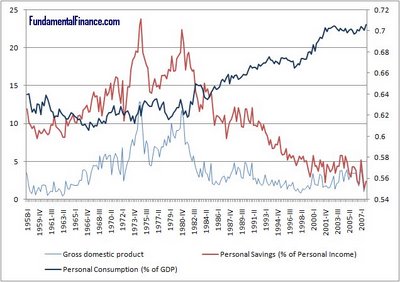


What was driving more consumption as a percentage of GDP? Decreased savings, of course! Over the past three decades, consumers have decreased the amount of money the spent--decreasing it a bit more each year. This fueled growth in consumption. So what happens when consumers no longer have any income dedicated to savings? They can no longer transfer savings to consumption. Then a valuable source of GDP growth dries up. Then we have a recession.

Hopefully the recession will serve a good purpose. The decrease in savings essentially represents a lifestyle change. Fundamental principles for giving mortgages have been abandoned--loans were even given at over 100% of a home's value. Home equity lines of credit have become common. Credit card debt has sky-rocketed. These trends have enabled consumers to have more "stuff", even though they have no savings.

Right now, credit is tightening. It's getting harder to borrow money. This is a necessary adjustment to bring our consumption back to a reasonable level. Hopefully, people will get more nervous and begin saving more. Unfortunately, a recession is the only way we can make this adjustment. We have to consume less in the short run, which is going to adversely affect the GDP.

My question is, what is going to happen in the next two decades? I don't think that consumers are suddenly going to build the personal savings rate back up to previous levels. If we do, there will be a period of slower growth than the last two decades. If we hold our savings rate constant (at just above 0), then we're giving up future consumption and allowing foreigners to take all the gains.

It seems to me we're in a predicament.

Finance Humor

I've finally gotten around to adding a blog to FundamentalFinance.com. I'll try to discuss news topics and some political-economic topics, similar to some of the stand-alone pages I've already posted (poverty, charity, corporations, etc.).

For starters, I saw this hilarious spoof on YouTube, so I figured this would be a good way to start the blog.


While I laugh every time I see this, it really does stink that there are people who have to stand on a corner every day in order to get work. I pass a group of about 10-20 Hispanics every day on the way to my office. What can we do about poverty? I'm not sure, but if I read anything interesting I'll be sure to post it. I'm certainly opposed in principle to government hand-outs. I'm not opposed to private charities and free-market solutions. One thing I do believe, is that the Hispanics I pass every day are probably better off than they would be in their native countries. That still doesn't make them well-off by American standards, but it's a step in the right direction.